Christine Swane
née. Larsen (1876-1960)
Spruce forest. 1959. Oil on canvas. 65 x 75 cm. Johannes Larsen Museum. Photo: Jens Frederiksen
Christine Larsen was born in Kerteminde and was the sister of the bird painter Johannes Larsen. Her artistic talent was noticed early on by the painter Viggo Johansen, who in 1896 was spending the summer with the Larsen family in Kerteminde. Viggo Johansen was head of the Art School for Women affiliated with the Royal Danish Academy of Fine Arts – female painters were not welcome at either the Academy or Zahrtmann’s School – and he encouraged Christine Larsen to apply for admission to the Art School for Women and thus begin a professional artistic education.
Going her own way
Christine Larsen therefore moved to Svanninge to receive drawing lessons from Fritz Syberg, both privately and at the Technical School in Faaborg. She was then admitted to the Art School for Women and moved to Copenhagen to further develop her artistic work.
However, the Art School proved to be a disappointment, whereas the lessons Christine Larsen received concurrently from the painter J.F. Willumsen opened up new artistic possibilities and directions, which she later chose to pursue.
Despite the family connection to Johannes Larsen and her close friendships with the Funen Painters, Christine Larsen consistently followed her own path and developed an independent artistic expression.

Inspired by Cubism
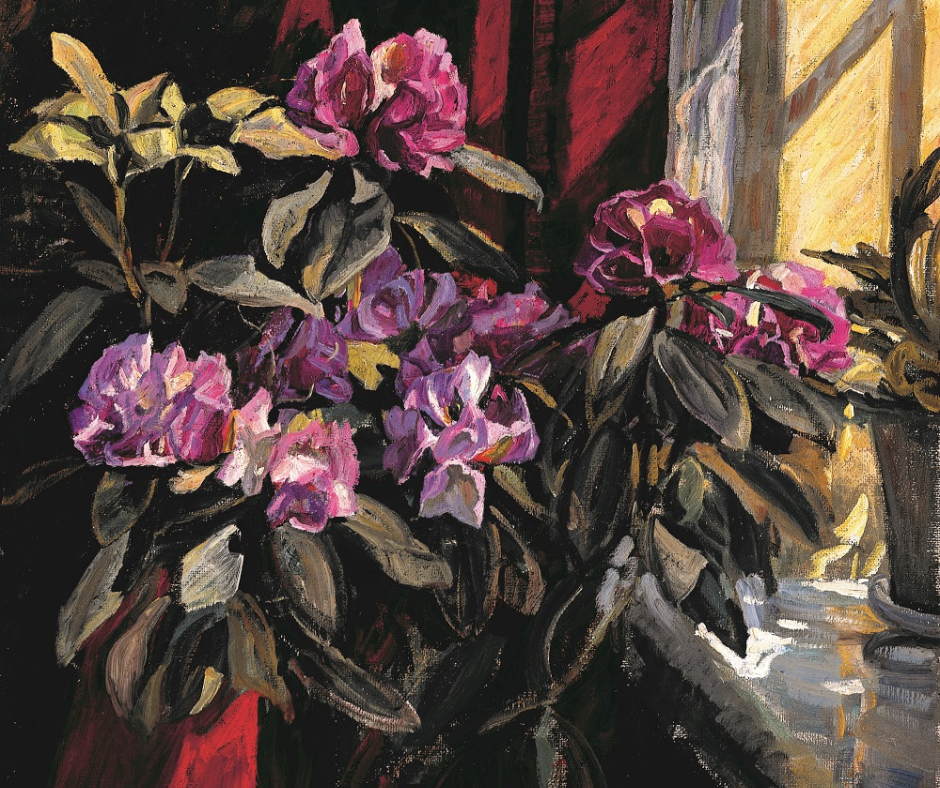
In addition to painting – both oil and watercolour – Christine Larsen also worked with textiles and embroidery, mosaic, and ceramics. She gradually distanced herself from the naturalistic painting of the Funen painters and was instead inspired by Cubism and modern European art. This inspiration came in part through the Swedish painter Karl Isaksson and Sigurd Swane (1879–1973), whom she married in 1910.
The marriage was turbulent, but the couple had a son together, Lars (1913–2002), who, like his parents, chose an artistic career. Christine and Sigurd Swane were divorced in 1920.
The trio Karl Isaksson, Christine Swane and Sigurd Swane were strongly inspired by the new French art. Christine Swane’s work increasingly focused on a systematic exploration of surfaces, forms, and colours. Her preferred palette was dominated by green in many shades, complemented by blue and yellow in a transparent, cool, and light style.
Colours, light and materials
In 1935, Christine Swane settled in Birkerød, where she moved into a newly built functionalist villa – a striking contrast to the Funen Painters’ preference for farmhouses and pastoral idylls. Since her divorce in 1920, Christine Swane had lived with her unmarried sister Rie, who kept house for her, and this close collaboration continued until Rie’s death in 1954. After that, Christine Swane lived with her son, Lars Swane in an artistic community in Farum until her death.
Throughout her life, Christine Swane worked seriously and purposefully with her art in a continuous exploration of colours, light, and materials. Her artistic practice was characterized by immersion, experimentation, and a constant development of her personal expression.
In 1936, Christine Swane became a member of the artists’ association Grønningen. Throughout her life she received a number for recognitions and awards, including the Eckersberg Medal in 1943 and the Tagae Brandt Travel Scholarship in 1938, and she undertook numerous study trips both in Denmark and abroad.