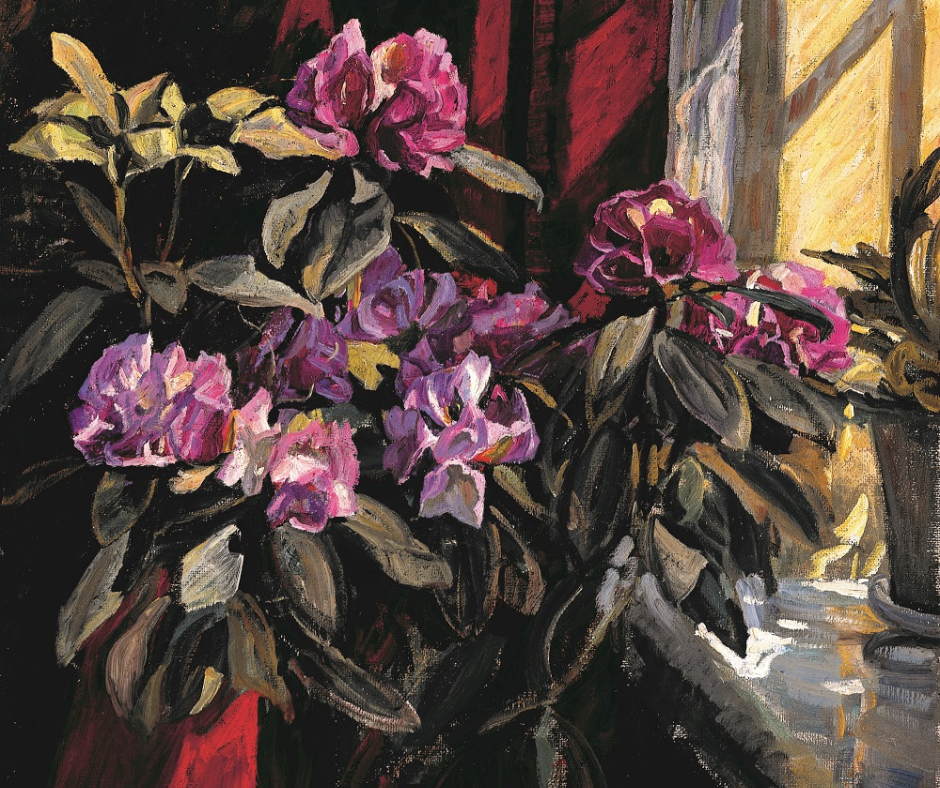
Johannes Larsen: The Ugly Duckling. One evening the sun set so blessedly. 1945. Watercolour. 20,7 x 25 cm. Owner and photo: Johannes Larsen Museum
Johannes Larsen (1867 -1961)
Born in Kerteminde as the eldest son in a prosperous merchant and shipowner family. On his mother’s side, there were several painters, so Johannes grew up with art as a close and natural part of his life.
When Johannes Larsen was seven years old, his farther purchased a forest estate, Båxhult, in Småland, which came to have great significance for the entire family.
From an early age, the young Larsen accompanied his farther on hunting and fishing trips, where his lifelong interest in observing and depicting nature was formed. His many preserved drawings from childhood show that he was not only able to render his observations accurately, but also to compose an image.
The formation of The Funen Painters
Despite Johannes Larsen’s clear talent for and desire to pursue an artistic career, his farther insisted that he complete a preliminary exam (realeksamen). He therefore travelled to Copenhagen in 1884 (at the age of 16), took his exam that same summer, and then began his artistic training.
At that time, there was almost a state of war between the Royal Academy of Fine Arts and the independent study schools, and Johannes Larsen had to choose a side: he chose the latter – entirely in keeping with his family’s Grundtvigian background.
In this way, Johannes Larsen came to spend five crucial formative years studying under Kristian Zahrtmann. Here he formed a number of lifelong friendships, most notably with Fritz Syberg and Peter Hansen, and he absorbed the artistic education that at the time could only be obtained in Copenhagen.
In the early years, Johannes Larsen primarily painted portraits as well as depictions of interiors and exteriors. If he wanted to make a living as a painter, portraits were usually the most profitable, but from around 1893 he increasingly chose birds as his subject, often in watercolours in the style that became particularly his own: drawn with a reed pen and ink, and then colored with watercolor.
Still in opposition to the Royal Academy of Fine Arts, Johannes Larsen and his circle of friends joined Den Frie Udstilling (The Free Exhibition), where he had his breakthrough as one of The Funen Painters.

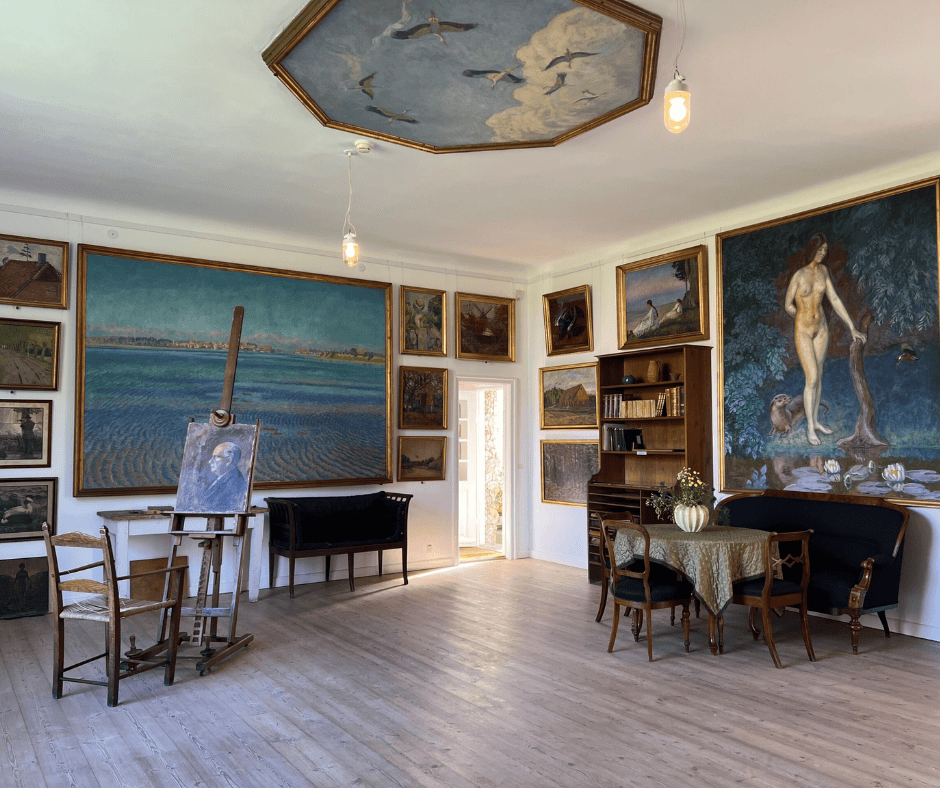
The Artists’ home at Møllebakken
Through Fritz Syberg and Peter Hansen, Johannes Larsen came to know Alhed Warberg, the daugther of a Funen estate manager. They first met in 1889, but it was not until 1898 – when Johannes Larsen was earning the equivalent of a skilled worker’s annual wage from his paintings – that he and Alhed dared to marry. In 1899, their first son, Jeppe Andres (”Puf”), was born, and in 1901 their second son, Johan (”Lysse”), followed.
At the same time, the foundation was laid for what would become Johannes and Alhed Larsen’s artists’ home at Møllebakken, designed by the architect Ulrich Plesner based on Johannes Larsen’s sketches and ideas.
Their close friends, Fritz and Anna Syberg, purchased Pilegården north of Kerteminde in 1902 and moved in the same year that Johannes and Alhed Larsen’s villa at Møllebakken was completed.
The times were on Johannes Larsen’s side: artistic taste was changing, and both his watercolours and oil paintings – featuring landscapes, weather, and animal and bird life – aligned with the period’s interest in outdoor life, vitalism, and a search for a simpler way of living. From 1902, Johannes Larsen also began working very successfully with etchings, and from 1904 with woodcuts, opening up new possibilities for, among other things, book illustrations.
In search of motifs
In may 1907, Alhed and Johannes Larsen travelled to the United States for about half a year with their two sons. After the journey Johannes Larsen’s oil paintings shifted towards a more modernist style, with broader brushstrokes and a new use of colour that appealed to both critics and buyers. The motifs remained bird life and coastal scenes, but the expression was new and modernist. He also experimented with lithography (1908) and produced a small series of animal sculptures carved in wood (1909-10).
In 1910, Faaborg Museum was founded, Johannes Larsen’s early works held a central place in the collection from the very beginning.
Johannes Larsen travelled in search of his motifs; the west Jutland lake Filsø became an important location for his large-scale coastal and bird paintings. He spent months at a time along the coasts, often in winter, when he had the opportunity to study migratory birds and the distinctive light of the season. Sprogø, Snave Strand and Fyns Hoved were visited in all kinds of weather.

A love of animals and nature
In 1910, Johannes Larsen’s parents died within a few months of each other, and the painter took on the role of head of the family – for better or worse. There were debts in the estate, but also many properties where family and friends could conveniently be accommodated. His sons had grown into young men, and the youngest, Lysse in particular, had inherited his father’s interest in nature and wildlife. He therefore took care of the animals at Møllebakken when Johannes Larsen was away on his long expeditions – and there were many animals. Primarily birds, of which a pair of swans and the peacocks were probably the most exotic, but also mammals, including a seal and a tame otter.
During this period, Møllebakken became a gathering place for large parts of Danish cultural life: painters, writers, sculptors, and critics stayed for shorter or longer periods at Møllebakken or in one of the Larsen family’s many houses in Kerteminde.
During the First World War, Johannes Larsen’s paintings sold well and at high prices. This made it possible to expand Møllebakken, adding a large new bathroom, a workshop, and more. A steady stream of guests arrived and stayed for shorter or longer periods – at the expense of the household. When the economic climate declined in the early 20’s, the Larsen family was affected, but their finances recovered again after a few lean years.
Migratory birds and the loss of Alhed
The publication in 1914 of Steen Steensen Blicher’s poem ”The Migratory Birds”, illustrated with 76 woodcuts by Johannes Larsen became a classic. In the early 1920s, when finances were strained, Johannes Larsen produced a series of woodcuts with animal and bird motifs, which Alhed and their son Puf printed in the workshop at Møllebakken. The era of “goulash barons” may have been over, but many people could now afford graphic prints at a much lower price than paintings. From 1921 to 1924, Johannes Larsen embarked on an annual summer voyage aboard the expedition ship Rylen together with the writer Achton Friis. This resulted in the major work “The Islands of the Danes”, which made Johannes Larsen a household name. Over the four summers that Rylen was at sea, they visited 132 islands, of which 74 were inhabited.
In 1927, he travelled to Iceland, where he worked on illustrations for the Icelandic sagas. On his way home from Iceland, he received the news of Alhed’s death. She had suffered from heart problems for several years. Johannes Larsen’s 60th birthday later that same year was marked quietly; the loss of Alhed and several friends who passed away during those years was deeply felt.
An advocate for nature
Throughout the 1930s, Johannes Larsen received a wide range of honours on recognition of his work, and he was also granted a state honorarium (Statens Hædersgave) through the Finance Act. However, he declined it in 1942 when it was withdrawn Martin Andersen-Nexø, Hans Kirk and C.E. Soya with reference to the anti-communist legislation. He did not wish to receive anything that depended on political views.
In the 1930s, his engagement in the nature conservation movement also gained momentum. As early as the 1920s, he had protested against plans to carve a monument into the soft chalk of stevns Klint, and he had become chairman of the Danish Society for Nature Conservation’s local committee in Kerteminde. He now used his name and position to defend and preserve nature.

Studies of light and water
In 1941, Tulle and Nan Due Nielsen moved into the seaside pavilion Pax in Kerteminde, and they commissioned Johannes Larsen to decorate the large hall. This marked the beginning of a friendship and a local exhibition venue – and of the Pax Collection, which was later on donated to the Johannes Larsen Museum.
After the war, Filsø lost its appeal for Johannes Larsen: the lake was drained and converted into farmland, so Larsen found a new base at Knuthenborg on Lolland. Despite his age, he continued to travel in search of motifs: Romsø, Tranekær, Holstebro and visits to family at Båxhult. Once again, watercolor became his preferred medium – and he continued to grapple with the motif of “the great wave”, among other ways through daily swims in the bay, where he studied light and water.
On 20 December 1961, Johannes Larsen passed away peacefully at his home at Møllebakken, one week before he could have turned 94.