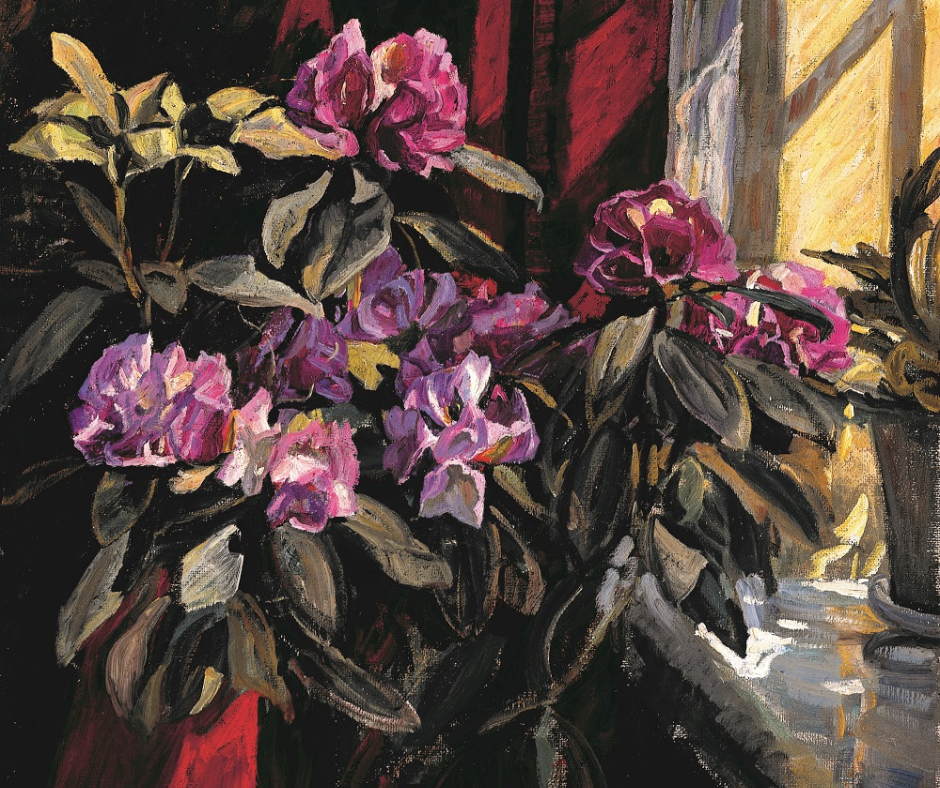
Peter Hansen: The pigs are herded out. 1904. Oil on canvas. 64 x 77 cm. Johannes Larsen Museum. Photo: Inferno
Peter Hansen (1868-1928)
Son of master painter and decorative painter Syrak Hansen of Faaborg, and brother of Anna Syberg. In 1875, at the age of seven, he went to Copenhagen with his brother to attend school, and he passed the preliminary exam (upper secondary school exam) at Efterslægtens School in 1883. He then returned to Faaborg and apprenticed with his father, but the following year he went back to Copenhagen to study under Kristian Zahrtmann at the Artists’ Free Study Schools (Kunstnernes Frie Studieskoler). There, during the school’s first year, he connected with Fritz Syberg, whom he already knew from his father’s workshop, and Johannes Larsen from Kerteminde. The three formed the core of what later became known as the “Funen Painters”.
At the same time, he trained as a parliamentary stenographer together with his sister Marie, and during his years of study he also earned a living as a theatre painter.
In 1898, Peter Hansen married Elise Neckelmann. They had two daughters.
Faaborg, Copenhagen og Italy
A central figure in Peter Hansen’s career as an artist was the insurance director Wilhelm Hansen, who founded the Ordrupgård collection. The two got to know each other as early as their school days and remained close friends. They influenced each other mutually; among other things, they both had great respect for manuel craftsmanship, and when Wilhelm Hansen later began collecting art, he purchased Peter Hansen’s paintings generously.
Although Peter Hansen is counted among the Funen Painters, he was just as strongly connected to Copenhagen. His entire schooling took place in the capital, where he also received his artistic training – and from 1905 he settled on Enghavevej, living there during the winters, while the summers were usually spent on Funen. In addition, Peter Hansen stayed in Italy during several periods, including 1903-05.
Peter Hansen’s works almost always feature people as their subject – people captured in the midst of everyday life: at work, at play, in contemplation. He was a master at capturing colour, light, and movement in a new and groundbreaking way, and his cropping of motifs was often innovative as well.

”I paint what I see,”
Peter Hansen’s painting from Italy titled ”The Manure Collectors”, helped spark the so-called ”peasant painter controversy” in 1907, during which the symbolist painter Gudmund Hentze, in a newspaper article in Politiken raged: ”What has he gained from experiencing that wonderful Italy? He has brought back no style, neither good nor bad – donkey manure is what he has gathered – honestly and earnestly – just as his nature is through and through”.
Peter Hansen, for his part, had little understandings of either the Symbolists’ or the other “isms” projects: “I paint what I see,” he declared.
In 1916, Peter Hansen lost interest in painting in Copenhagen; the subjects no longer spoke to him. He returned to Faaborg, where he purchased the rear building of his father’s painting business at the address Lagonis Minde 7. There, he established a small home, a studio, and a small garden, and he lived and worked there until his death in 1928. Earlier that same year, he had been made an honorary citizen of Faaborg.