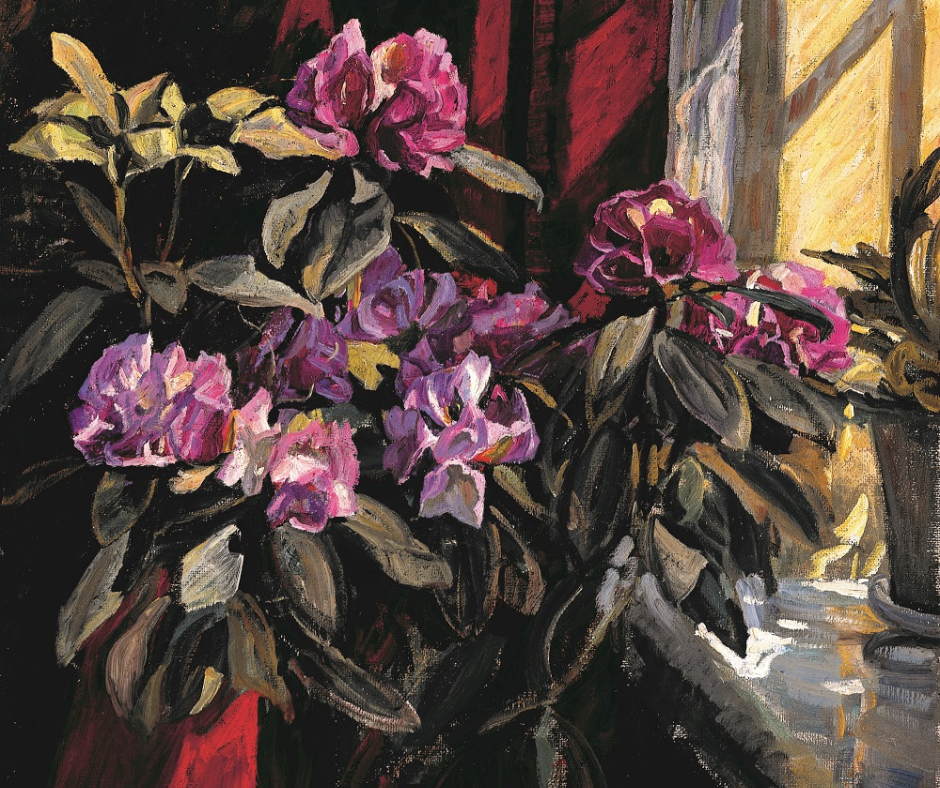
Alhed Larsen: Anemones. Undated. Oil on canvas. 18.25 x 38,5 cm. Private collection. Photo: Gregory Staley
Alhed Larsen (née Warberg) (1872-1927)
Alhed Warberg was born as the second eldest daughter in a family of eight at the estate manager’s residence Erikshåb, which belonged to the South Funen estate of the Schaffalitzky de Muckadell countship. The family was well-off, and when Fritz Syberg arrived in the area in 1885 as a young aspiring artist – his uncle was also an estate manager within the same estate – he was employed as a drawing and painting teacher for the seven girls of the Warberg family. Alhed in particular showed both interest and talent.
In Syberg’s wake, the Hansen family (Peter, Anna and Marie – from Mesterhuset in Faaborg) also appeared at Erikshåb, along with Syberg’s friend from Zahrtmann’s School, Johannes Larsen from Kerteminde. For four summers in the late 1880s, Erikshåb became a gathering place for the young artists, before life led them on in new directions.
In 1890, Alhed Warberg travelled to Copenhagen to pursue her education. She lived with her uncle, the sculpter Ludvig Brandstrup, who gave her drawing lessons, while she worked at the Royal Porcelain Factory as an underglaze painter. In 1893-94, she travelled to italy with the Brandstrup family, and afterwards returned to Erikshåb. She never received any formal artistic training.
A new life in Kerteminde
The lively and outgoing Funen painter Peter Hansen eagerly courted Alhed, and it was not until the mid-1890s that the serious and reserved Johannes Larsen managed to win her over. The couple married in 1898, and in the summer of 1902 – after many years of hard work on Johannes Larsen’s part – the family’s new home at Møllebakken was ready for them to move in. In the following years, the property was gradually expanded with a guest house, a workshop, a winter garden, and more.
Alhed Larsen had continued to work with drawing and painting throughout, and she carried on doing so – interrupted by the births of the couple’s first son in June 1899 and there second in 1901. Unlike her husband, she was outgoing and sociable and became the centre of social life at Møllebakken.

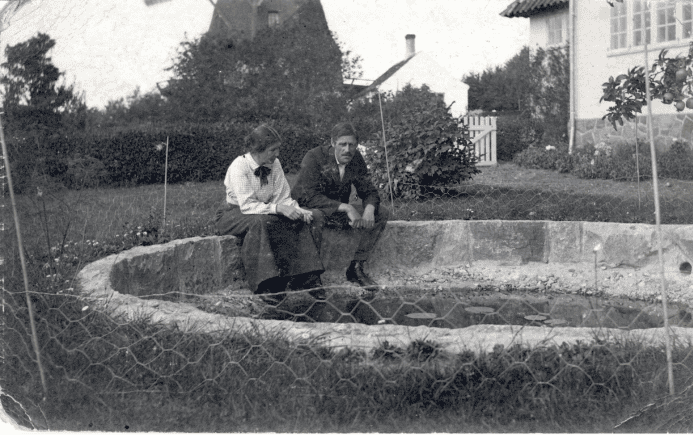
The home and garden as the primary motif
Like other female artists of the time, she had to balance her roles as wife, mother, and hostess with her ambition to develop as an artist. Over the years, she succeeded in maintaining a small but steady output of new works – both oil paintings and watercolors, and in later years especially pastels on paper. Her motifs were found in the home and garden, where she explored color and the play of light.
Between 1900 and 1906, she exhibited five times at the Charlottenborg Spring Exhibition. In 1912, she organized an exhibition at Den Frie Udstillingsbygning together with Christine Swane, Anna Syberg, and three other female artists.
Over time, Johannes Larsen was often away from home on travels, and in his absence Alhed Larsen managed the “business”, including the sale of works, the production of woodcuts, and more. She was also always involved in decisions regarding the hanging of exhibitions.
From her mid-forties, Alhed Larsen experienced increasing health problems. She contracted the Spanish flu but survived. Hives became a recurring affliction, and she also developed heart problems. She died on 31. August 1927, while Johannes Larsen was on his way home from a trip to Iceland.